

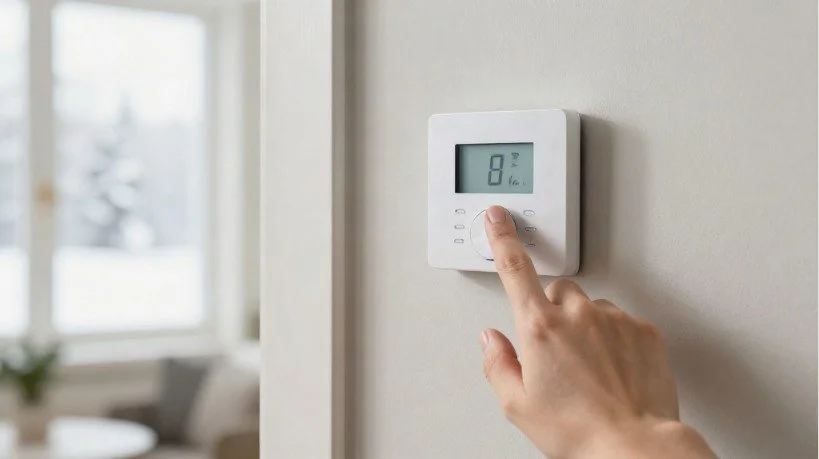
If you have priced a smart thermostat in Ottawa, you have probably read the same promise: control your heat from your phone and watch your heating bill drop. That promise is partly real and partly marketing. This guide answers the questions Ottawa homeowners actually ask before they spend the money - what these devices control, where the savings come from, and the point at which you should stop troubleshooting and call a licensed tech.
Do smart thermostats actually lower heating bills in Ottawa?
Yes, but not by magic and not by as much as the box suggests. A smart thermostat lowers your bill the same way a good programmable thermostat does: it stops you from heating an empty house. What makes it smarter is that it learns your schedule, adjusts for outdoor temperature swings, and can be controlled remotely when plans change.
In a cold climate like Ottawa, that matters more than in a mild one. Our heating season is long, and every hour your furnace or heat pump runs at full comfort temperature while nobody is home is money out the door. A thermostat that reliably backs the temperature off during work hours and overnight, then recovers before you wake up, is doing real work on your behalf.
What it cannot do is fix an inefficient system. If your furnace is undersized, your ducts leak, or your heat pump has lost its charge, a new thermostat will just manage a problem more neatly.
What does a smart thermostat actually control?
This is the part people most often misunderstand. A thermostat is a switch, not a heating system. It does not change how much gas or electricity your equipment consumes to produce a given amount of heat.
What it controls is when your system runs, how long it runs in each cycle, and at what target temperature. In an Ottawa home, that typically means:
- Setting a lower target while you are at work or asleep
- Holding a steady temperature instead of overshooting through short cycles
- Adjusting for humidity and outdoor temperature so the house feels consistent
- Letting you nudge the temperature from your phone before you get home
Everything else - the furnace, the heat pump, the blower, the ductwork - is still doing the heavy lifting.
How is it different from a programmable thermostat?
A programmable thermostat follows a schedule you set once and then mostly forget. It works well if your routine never changes. It fails quietly the moment your week gets irregular, because it keeps heating an empty house on schedule while you are away.
A smart thermostat adapts. It notices when you are home, learns how your house warms up and cools down, and factors in the weather. Geofencing on your phone can flip the system to an away setting when the last person leaves. Many models also report runtime data, which is genuinely useful: you can see how many hours a day your equipment actually runs.
For a household with a predictable schedule, the difference may be modest. For a household with shift work, travel, or kids moving in and out, the difference is bigger.
Where do the real savings come from in a cold climate?
In Ottawa, savings come from three places, roughly in this order:
Setbacks that actually happen. Dropping the temperature 3 to 4 degrees for eight hours a day is where most of the gain lives. The harder part is consistency, and that is exactly what a smart thermostat is good at.
Fewer recovery spikes. A smart thermostat can start your system earlier at a gentler pace instead of blasting it to catch up, which is easier on equipment and often uses less energy.
Better visibility. Runtime and usage data let you spot a system that is working harder than it should. That early warning often saves more money than the setback schedule does, because it gets a small issue fixed before it becomes a winter emergency.
Be skeptical of headline percentages. Manufacturer savings claims are usually measured against a house that was heating itself to a constant temperature with an old thermostat, which is not the same as your house. Treat any single number as a ceiling, not a forecast.
Where do the claims get oversold?
A few honest caveats before you buy:
- Your thermostat is only one variable. Insulation, air sealing, window condition, and equipment age usually matter more.
- Heat pumps need care. A smart thermostat has to be compatible with your heat pump's defrost cycles and auxiliary heat settings. Set up wrong, it can raise your bill or strain the system.
- Big setbacks and slow recovery do not always mix. With some systems, asking for a large temperature drop and a fast recovery is less efficient than a moderate, steady setback.
- The hardware is not the service. A thermostat swapped in without verifying your equipment's settings is a missed opportunity at best.
If a product pitch promises a specific dollar figure on your bill with no look at your home, that is a pitch, not an assessment.
How should you set one up for an Ottawa winter?
A sensible starting setup for most Ottawa homes:
- 20 to 21 degrees Celsius while you are home and awake
- 16 to 17 degrees while you are asleep or away for the day
- A gradual morning and evening recovery rather than a fast blast
- Away mode enabled, especially if you travel during heating season
- Alerts turned on for long runtimes, so you hear about a problem early
If you have a heat pump, leave the auxiliary heat lockout and defrost settings to someone who knows your equipment. That is not a menu to explore by trial and error in January.
When should you call a licensed tech?
Call a licensed HVAC technician if:
- Rooms heat unevenly no matter how you set the thermostat
- The system runs constantly and still does not reach the target temperature
- You see sharp jumps in runtime after a thermostat change
- Your heat pump switches to auxiliary heat in mild weather
- You are pairing a new thermostat with a heat pump, boiler, or multi-zone system
These are usually signs of a system problem rather than a settings problem, and they get more expensive the longer they sit through an Ottawa winter.
The bottom line
A smart thermostat is a good investment for most Ottawa households, but it is a controller, not a cure. Expect it to trim your heating bill by managing setbacks, recovery, and runtime rather than by transforming how your furnace or heat pump performs. If your equipment is healthy and your schedule is inconsistent, the payoff is real. If your system is struggling, the thermostat will simply manage the struggle more conveniently.
MMP Home Solutions installs, repairs, and maintains furnaces, heat pumps, boilers, and ductless systems across Ottawa, Kanata, and Nepean. If you want a straight answer on whether a smart thermostat will help your home - and a proper setup if it will - get a free quote. No pressure, no jargon, just a licensed tech who has seen your type of house before.
